

John Slater – a bantam

Bantams
Each one a pocket Hercules
five feet and a bit,
a kind of Bovril essence
of six foot British grit
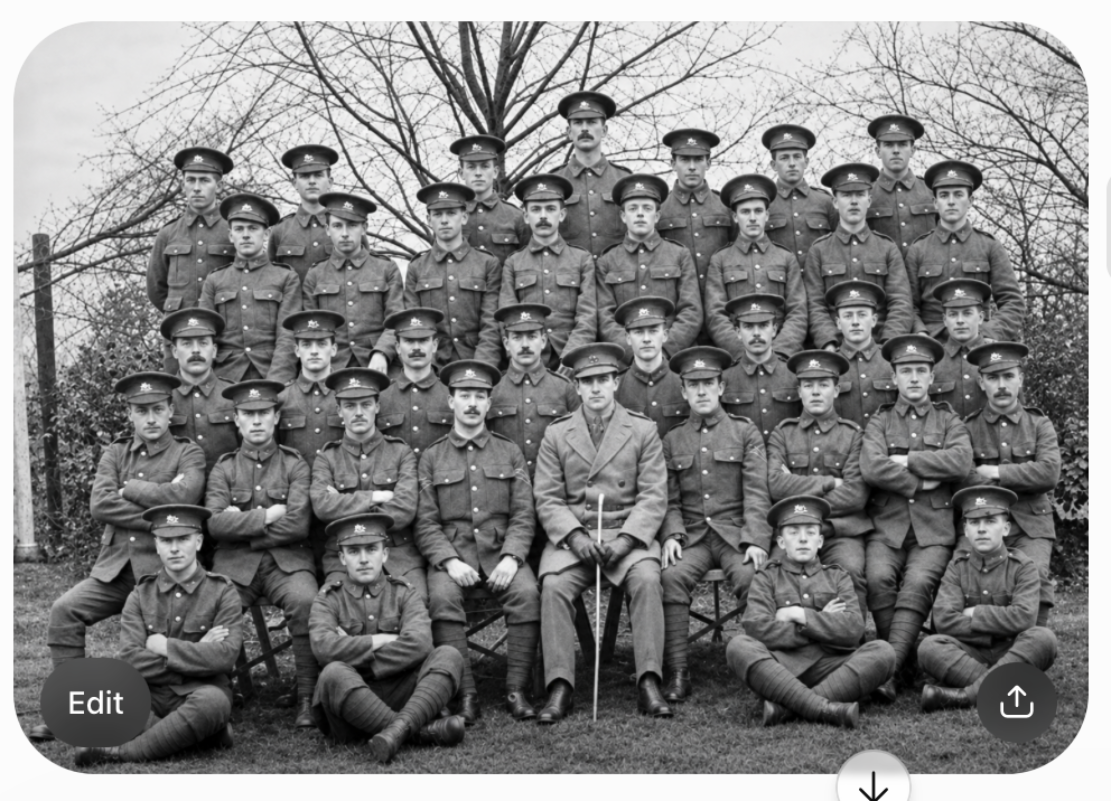
Number 8 Platoon, 11th battalion.
Like many people I have wanted to know what my grandfather, Alfred Slater, did during the first world war. I never knew my grandfather. He died in 1949, the year before I was born. All my father could tell me about Alfred’s experiences in WW1 was that he joined up before he was old enough and he worked with horses. So not much to go on there.
I searched in the usual places - Ancestry, Findmypast and Forces war records and drew a blank. Well that’s not quite accurate. I found plenty of Alfred Slaters but couldn’t identify which one was definitely my grandfather.
It was then that I was diverted. Alfred’s brother was John Slater. Maybe they’d joined up together. John was the elder brother. The 1901 census tells me that he was born in 1885 and Alfred in 1897. The family, Tom (father), Catherine (mother), Sarah(20), John, Maria (14), Thomas (11), Alfred and Ada(1) were living at 16 Appleby St, Blackburn. John was working as machine minder in a woodyard. By 1911 the family were split up; Tom was now in Blackburn workhouse; Alfred and Catherine were living with Sarah, now married, and her family at 19 Lawrence St, Blackburn. Alfred was 13 years old and working in a cotton mill as a dobby lattice maker. John had married Sarah Walmsley in 1908 and was living at 28 Maudsley St, Blackburn. He was a window cleaner.
I hit lucky when searching for John’s war record. It existed. Many WW1 service records were burnt or destroyed during the blitz. A person’s service record gives all sorts of information. John was described as being 5 feet and half an inch tall. Even for 1914 this was small. I was intrigued. Was there not a lower limit for height? Didn’t prospective soldiers have to have a medical? Would men as small as this not be excused military service and put to work in other occupations?
Further research on the Internet revealed that there was indeed a lower height restriction, 5ft 3in. Men were turned away who were smaller than this. However this ruled out many men who were fit, healthy and willing to fight. Many men from the industrial and coal mining areas of the North of England were excluded but they were desperate to fight and ‘do their bit’. Alfred Bigland, MP for Birkenhead took up their case. He wrote to Lord Kitchener asking permission to form a battalion of fit and healthy men between 4ft 10in and 5ft 3 inches tall. The 15th battalion, 1st Birkenhead, The Cheshire Regiment was formed and became known as the bantams.
The idea spread and bantam battalions were formed in other parts of the UK and Canada. Although the enlisted men were small the officers were of normal height as you can see in the photograph on the left. They acquired a formidable fighting reputation eulogised in the poem printed on this page. After pub fights in Glasgow, the 18th Battalion of the Highland Light Infantry, were known as the Devil Dwarfs by the locals.
The 11th (Service) Battalion, The King’s Own Royal (Lancaster) Regiment was raised in Lancaster on 25th June, 1915. John lived in Blackburn but travelled the 30 miles to enlist at Lancaster on 9th September of that year. He was 28 years old, married with 4 young children between the ages of 6 and 1, and worked as a window cleaner. Conscription did not come into place until 1916 and John, with a wife and family, might not have been faced with fighting until 1918. Maybe he thought he would earn more as a soldier than a window cleaner. He was given leave until the 13th of the month in order to sort out his business affairs, presumably his window cleaning business.
After basic training and, when the battalion was at full strength (October 1915), it was assigned to the 120th Infantry Brigade of 40th Division. They were stationed at Bourlay bottom camp, Aldershot where the men had their first chance to sleep under canvas. John was promoted to Lance Corporal on 19th October, 1915 and full Corporal on 27th May, 1916. Training continued at Aldershot and then Farnborough before the battalion was ordered to France and embarked on the SS Clemintine at Southampton on 2nd June, 1916, docking at Le Havre later that day.
The first casualty occurred two days later on 4th June. A man cut his hand when opening a tin. Although he went to hospital the wound became septic and the soldier died.
On 12th June the battalion was moved to Bethune for practical training in trench warfare. The men were issued with steel helmets. The battalion was attached to the 44th Infantry Brigade, 15th division which was in the line in the Hulluck section, 1 mile north of Loos. John was in B company and attached to 8th Battalion Seaforths. Each platoon was responsible for the repair and maintenance of one part of the trench system. The battalion continued to be employed in trench work for the rest of the year.
Meanwhile Sarah and the other soldiers’ wives depended on their husbands’ army allowance to survive. A separation allowance was paid to the wives of soldiers at the front. This was based on the number of children the couple had. For Sarah, with four children, this would have been 12s 3d of which 7s 7d was for the wife and the rest for the children. Before the start of the war the number of claims for separation allowance for the whole of the British Army was £1,100. With the advent of mass mobilisation this went up to over half a million. The Soldiers and Sailors Families Association (SSFA) was set up to help the wives and dependents make their claim since there was no administrative system in place to cope.
However one of the criteria for claiming separation allowance was that the wife be of ‘good character’. This moral judgement would have to be made by the SSFA representative. In March 1917 John’s Brigade commander received the following letter from the War pensions committee.
Sir,
I am directed by the War Pensions Statutory committee to inform you that no further issue of separation allowance will be made to the wife of no. 20802 John Slater, 11th battalion, King’s Own Lancashire Regiment in consequence of her immoral conduct with William Redfern.
In future, allowance at the ordinary rate will be issued for 4 children to her.
I am to request that the above information may be communicated to the soldier through his CO who should no longer be required to make an allotment to his wife.
I am sir,
your obedient servant,
the secretary
We can only speculate what went through John’s head when this news was conveyed to him. It would be another two years before he was discharged and returned home to sort things out with Sarah. Before then his battalion would be engaged in fierce fighting in Flanders
In April 1917 the battalion were ordered to advance as far as Beaucamp. During the 3rd Battle of Ypres they saw action. The battalion regularly patrolled no mans land and carried out several raids on German trenches. Three or four patrols of one officer and 20 other ranks would go out each night in order to secure control of no-man’s land and carry out raids on German trenches. This action continued until November 1917.
The Battle of Cambrai raged between the 20th November and 3rd December. The bantams were involved in the storming of and capture of Bourlon village and wood. This strategic position was eventually taken. Ten soldiers of the King’s Own were awarded the Military Medal.
On New Year’s Day, 1918 the battalion occupied a trench on the front line. “The enemy tried to fraternise but were met with machine gun fire and Lewis gun fire in response.’"Carter, p. 20). On the 2nd the battalion were moved to Brigade reserve. They remained in reserve with brief stints in the front line until 3rd February when orders were received for its disbandment. The unit were complimented on its good work and note was made of the fact that it bore the rare distinction of never once having its trenches raided.
As casualties had increased the bantam regiments had to be supplemented by taller soldiers just like the Pals battalions. The characteristic of this small fighting battalions changed.
Many bantams were redeployed in tank and tunnelling work in 1918. John was transferred to the 1st Battalion, King's Own Royal Lancashires. They saw action in the battles of Arras, Lys and Bethune. At the end of the war in November the battalion captured the towns of Querenaing and Pressea. John returned to England in March 1919.
He returned to his work as a window cleaner. He and Sarah had another child, Thomas, who was born in 1925. The family were still living in Maudsley St in 1939 and John was still working as a window cleaner. Sarah died 5 years later but John lived until 1968 when he would have been 83 years old.